
I loathe when people bring up meat tests to justify terrible ammunition choices. In my world, it’s commonly used to justify using birdshot for home defense. People have seen a ‘meat test’ and are convinced it’s a valid way to judge how a round will perform against a soft target. The idea of meat tests isn’t new.
Ballistics tests using meat go back more than a century, but were abandoned decades ago for good reason. They are not a repeatable or reliable testing mechanism for ballistic performance. Meat tests are fun and look cool on YouTube, but should not be trusted when picking a cartridge for defensive use.
Advertisement — Continue Reading Below
In terms of hunting use, same deal. It’s not a good test for hunting ammo unless the meat you shoot was grazing before you shot it.
Why Meat Tests Aren’t Valid
The alternative to meat is ballistic gel. Ballistic gel is the professional standard for testing cartridges. A lot of people will proclaim the human body is not made of gel, so how is ballistic gel valid? They are right to a degree. Ballistic gel wasn’t designed to be a one-for-one representation of the human body.

Advertisement — Continue Reading Below
Dr. Martin Fackler pioneered ballistic gel testing when he worked for the Army Wound Ballistic Laboratory. It’s designed to be a perfectly homogenous, repeatable medium for ballistic testing. It’s actually calibrated to match pig muscle, which is similar to human muscle tissue.
Meat tests do none of this. It’s not repeatable, it’s not homogenous, it’s not calibrated to be similar to human muscle tissue. Meat test enthusiasts will often claim that meat is a more valid testing platform than gel because people are made of meat.
Skin and Water
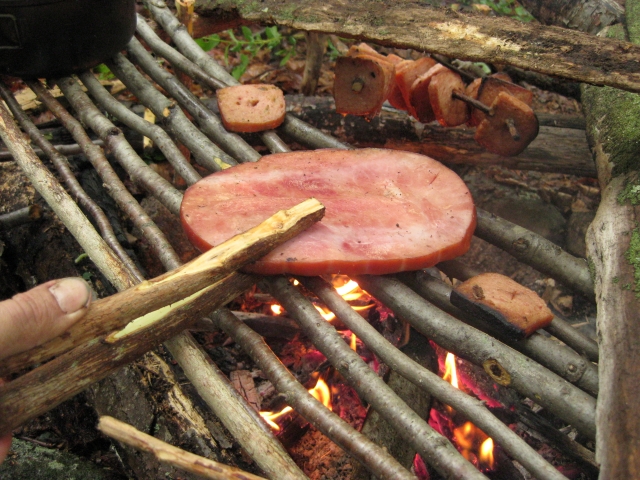
While true, people have meat, the meat from your local supermarket isn’t a worthwhile comparison. Supermarket meat lacks skin, it’s dehydrated, and has different degrees of tissue variation. Skin is an elastic material that does a pretty good job of protecting your insides.
Advertisement — Continue Reading Below

Skin offers excellent tensile strength and elasticity. When a bullet hits skin, it has to stretch significantly before it breaks, which is going to require a non-trivial amount of force.
Living tissue holds significant amounts of water. Lean muscle is about 70 to 75% water. Fat is 10 to 30% water. A person could easily be 50 to 60% water. Meat purchased in a supermarket has been bled out, aged, and hung. It’s experienced significant fluid loss, and it is not representative of human meat.
Advertisement — Continue Reading Below
Density and Temperature
Living muscle tissue is held under resting mechanical tension. Connective tissue sheaths house muscle fibers. When you butcher meat, the tension is lost. The muscle group is severed from its bone anchors. The tension disappears, relaxing and sagging.
Meat is often aged, and enzymes are breaking down structural proteins to make the meat tender. If the tissue is breaking down already, how well does it simulate living tissue?
Advertisement — Continue Reading Below
Supermarket meat has varying density spikes, and as you shoot the meat, you’re not getting any usable data beyond the small portion of meat that contacted the bullet. We also have to factor temperature. If someone is shooting meat, what’s the meat’s temperature?
Meat at 36 degrees is going to perform differently than meat at a living 98.6-degree temperature. The meat’s temperature can cause changes in the stiffness and mechanical behavior of the tissue. Cold meat is firmer than living meat. Meat can’t regulate its temperature, so it’s likely going to be too cold or too hot to provide realistic data.
Beyond Validation
Meat tests don’t offer a repeatable mechanism to test ballistic data. They don’t offer a realistic medium. They don’t offer anything beyond entertainment. I’m not a luddite; in fact, I’d argue that meat tests are the luddite solution. I’m open to newer, better testing for defensive cartridges, but meat ain’t it.
Advertisement — Continue Reading Below
Read the full article here