
We are awash in good-quality budget red dots these days. Optics like the ROMEO5 and the Holosun 403 provide an effective, albeit bare-bones, optical option for a fair price. It wasn’t always that way. There was a time when you had to decide between spending a mortgage payment on an Aimpoint or Eotech or buying a blister-packed airsoft optic. Then, a little optic called the Bushnell TRS-25 came along.
It came along at the right time. It was released in 2008, right in the middle of the AR-boom. When the AWB expired in 2004, the boom started. By 2008 it settled into a comfortable position where ARs were much more common and, more importantly, available at a variety of price points.
Advertisement — Continue Reading Below
Cheaper ARs called for cheaper optics. In 2007 Aimpoint introduced the T1 series, but at $600 to $700 that was literally a mortgage payment for me, or a month’s rent in 2008. Bushnell introduced the TRS-25 to very little fanfare, and its growth was propelled by word of mouth, internet forums, and even early Guntube.
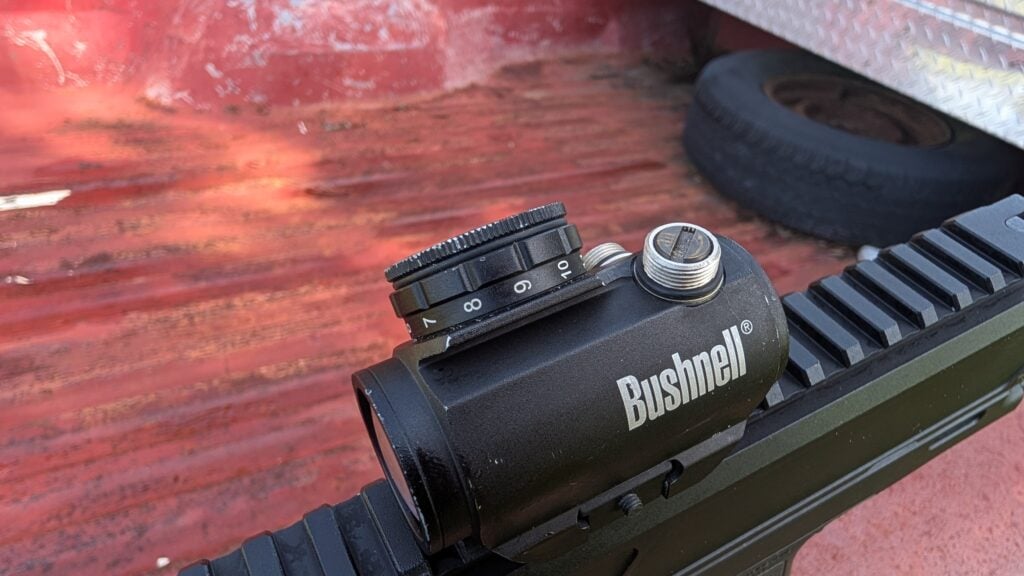
The Bushnell TRS-25
The Bushnell TRS-25 walked so the ROMEO5 and Holosun 403 could run. To be clear, these are all Chinese-made optics, but they represented a bit of a step up in what China could bring to the red dot market. There are some survivors from the before times, stuff like copies of the Japanese Ultradot Pan AV, but by and large the Bushnell TRS-25 helped propel cheap red dots into the future.
Advertisement — Continue Reading Below
I got mine the same way most people got theirs, from Amazon. It dominated the budget market space, and price fluctuations made checking your saved-for-later often feel like a lottery. The $40 price tag wasn’t always guaranteed; sometimes it would be $80 to $100, but we all knew the price would drop and we waited to snag one.
The Bushnell TRS-25 would often sell for rock-bottom prices. If you caught the optic on Black Friday, or a Veterans Day sale, you might spend fifty bucks on it. I bought mine for around $40-ish on sale. That was less than the price of a pair of MBUS sights. At that price point, everyone expected the optic to suck.
The TRS-25 – It Didn’t Suck
Surprise, surprise, it didn’t suck. Well, at the time, for the price, it didn’t suck. Hell, for $40, now it wouldn’t suck. The TRS-25 did two things well. It held up to abuse and maintained its zero. The dot was never some crisp perfect 2 MOA reticle, but it was bright enough to be seen in bright light conditions.
Advertisement — Continue Reading Below
In fact, when you dialed it up to eleven, and I meant that literally, 11 was the brightest setting, it would flare up and halo indoors. The emitter took up a chunk of your viewing window, which Bushnell assured you was normal.
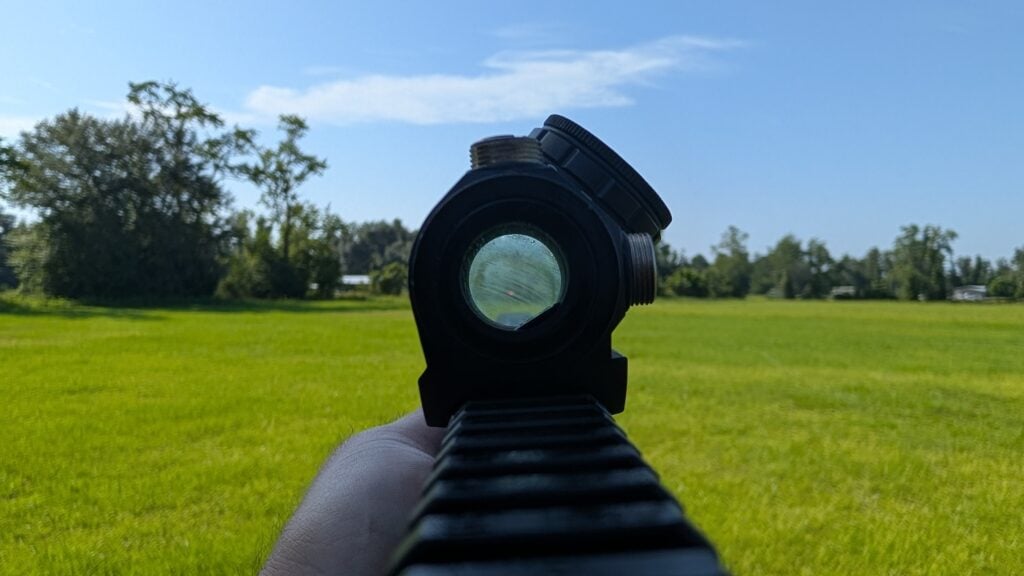
There were seemingly two different generations. One had the emitter to the bottom right, the other at the bottom center. Supposedly, the first gen with the right-side emitter was better, but it’s all the same to me.
Advertisement — Continue Reading Below
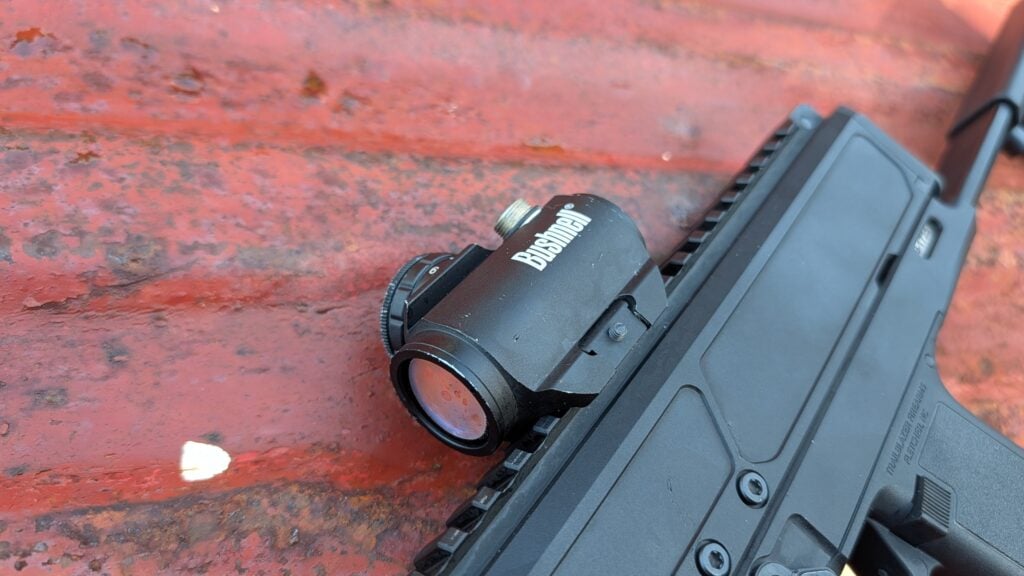
The lens has a distinct blue filter, like when a TV show is trying to tell you it’s cold outside. That notch filter kept battery life high and helped keep the dot bright. The downside is that it looked like you were looking through a submarine window at times.
The optic had a fixed mount and came in low and high. The higher-mounted models came with a riser and cost more. Like a lot of people, I grabbed the low-mounted version and the cheapest riser UTG could make, and that tended to be about ten dollars cheaper altogether than the tall model.
Advertisement — Continue Reading Below
On the Outside
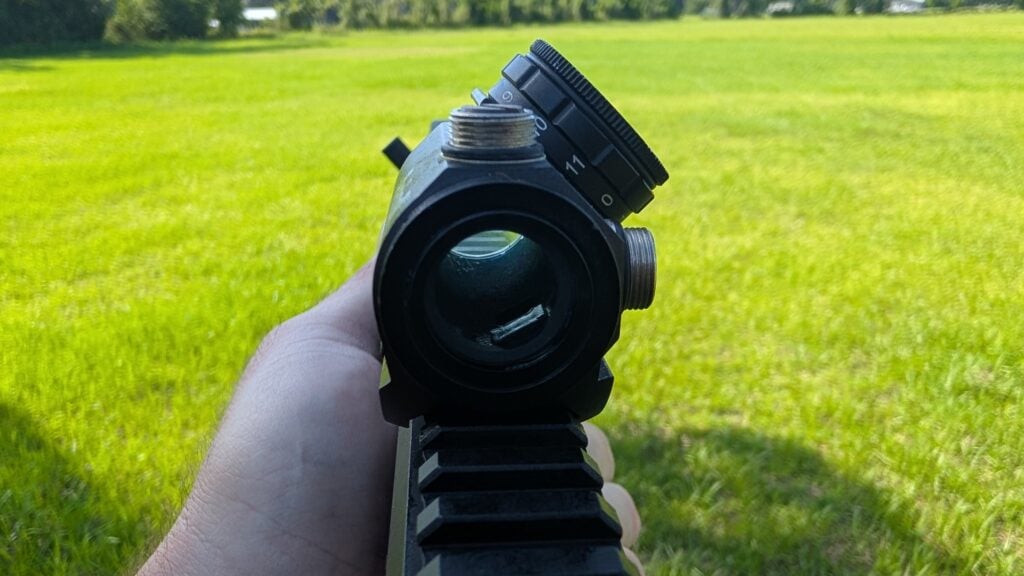
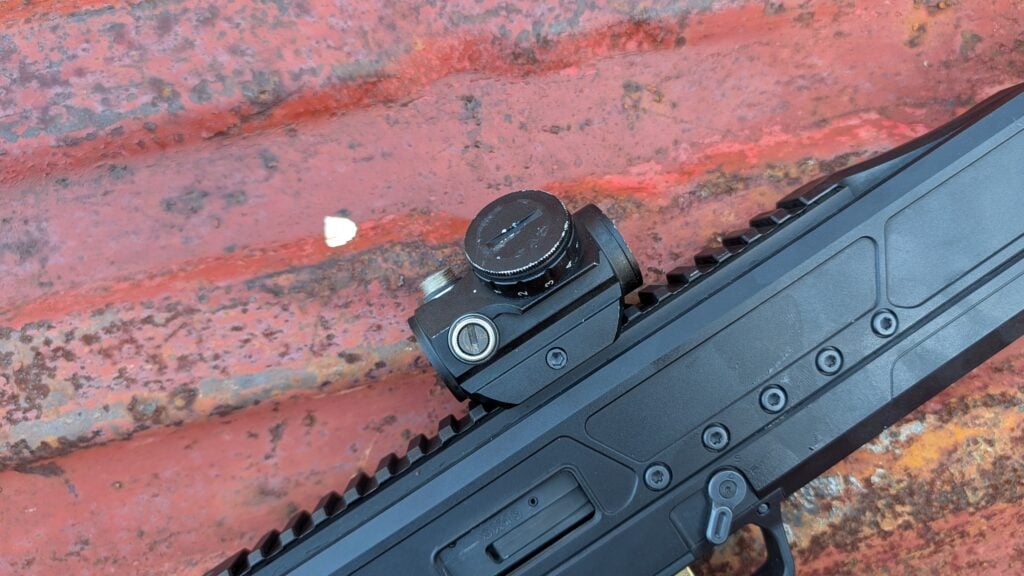
We got a rotary dial or rheostat for the more educated of us. No shake awake here. Turn it on, adjust as necessary, and try not to forget to turn it off. Bushnell advertised all of 3,000 hours of battery life. That sounds like a lot until you see the modern 50K battery life advertised. Eotech owners remain in shambles. In reality, it didn’t last that long, maybe half that if you shoot indoors.
The bolt was a tiny little thing that pinched the optic to the rail and worked as your only recoil boss. It’s not awe-inspiring by any means, but I don’t think many ever broke.
Advertisement — Continue Reading Below
The 25 in TRS-25 stands for 25 mm, which is the objective window size. It falls into that micro-sized tubular red dot format. We had two capped turrets, and I lost the caps a long time ago. I have no idea how many guns I’ve used the TRS-25 on.
It’s got to be at least 20 now. For a long time, it was the dot I moved between guns when reviewing them. It’s been zeroed and rezeroed and seen thousands of rounds and still works fine. It’s never stuttered under 12-gauge recoil, never flickered, or failed to come on.
The TRS-25 is a tough optic, deceivingly so for the price point. It’s outlasted one of my Romeo5s by a good margin.
Still Worth It
The TRS-25 is still being produced and sold. As of this writing, it’s roughly $70 on Amazon. At seventy bucks, it’s a bit of a tough sell. The reticle isn’t great, the battery life isn’t great, the notch filter is heavy, plus you’re stuck with the mount. For $20 to $30 more, you can get a Gen 2 Romeo-MSR and have a much better optic.
Bushnell tried to capture that lightning in a bottle by introducing the slightly upgraded TRS-26. This optic used an Aimpoint footprint, buttons, auto-shutoff, and a slightly bigger lens. Alongside all these upgrades was a higher price point.
The price point seemed to kill the optic’s momentum, and I’ve never seen anyone actually own one. The TRS-26 didn’t replace the TRS-25 by any means. Bushnell would rebrand the TRS-25 the AK25 as part of their short-lived AK optics lineup and produce the two side by side.
These days it’s a tough sell, but the TRS-25 helped shape the budget red dot market we have now.
Read the full article here