
Like most countries in a post-World War I world, the Japanese had a desire to field a self-loading rifle. “Self-loading” is the fancy way to say semi-automatic and magazine-fed. From 1932 to 1935, they produced three rifles for military use. Only one was formally adopted, but their experiments are still interesting, and today we are going to cover each of the four Japanese Self-Loading rifles.
Self-Loading Rifles Worth Remembering
Sadly, information on these rifles is fairly scant. I’m having to use Google Translate and search through various Japanese webpages for information. The only rifle with a fair amount of information is the Type 4 rifle, which was adopted but fielded in extremely small numbers. Let’s dig into what we know.
Type Hei Rifle
The Type Hei rifle, also called the Automatic Rifle Type C during its production, is a 6.5mm Arisaka rifle. Both the Japanese source I’m relying on and Ian at Forgotten Weapons state Nippon Special Steel Co. as the manufacturer.
Advertisement — Continue Reading Below
This rifle used a system similar to the Pedersen system designed for the Pedersen Rifle. This is a toggle-delayed blowback system that was tested by the U.S. Army and proved favorable with the .276 Pedersen round. The Japanese used the same basic action, but designed it to use a gas-operated system.
This self-loading system would have less recoil than the Pedersen designs, and a lot less than the bolt-action rifles soldiers were already used to. The rifle held 10 rounds in a removable magazine, but could be loaded via stripper clips from the top.
Advertisement — Continue Reading Below
Two variants were produced, a carbine and a full-length rifle. Barrel lengths are difficult to find, and the Japanese source seems to list the overall lengths and weights. The carbine was 42 inches long, and the full-sized rifle was a hair under 44 inches. The Carbine weighed 7.49 pounds, and the full-sized rifle weighed 8.8 pounds.
The Type Hei was on the verge of adoption, but the outbreak of the Second Sino-Japanese War postponed the adoption.
Type Ko
The Type Ko rifle was designed by the Japanese Military and Kokura Arsenal. Much like the Type Hei, this rifle copied the Pedersen design. Pedersen showed his rifle to Japan, and they seemed to like the rifle’s simplicity.
Advertisement — Continue Reading Below
Unlike the Type Hei, the Type Ko utilized an almost direct copy of the Pedersen system with all its downsides: namely, more recoil and extreme extraction due to the high-pressure design. The Ko rifle used a 10-round rotary magazine, which is fairly interesting for the era, and it is an internal box magazine that’s not removable.
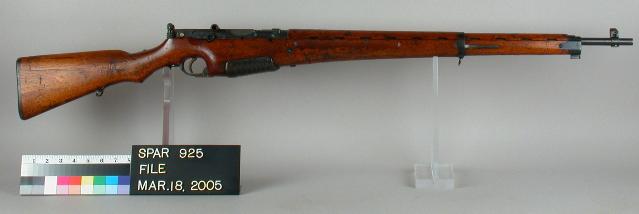
Pedersen used a wax coating to allow for the utmost reliability from his rifle design, and it doesn’t seem like he shared that idea with the Japanese, according to Ian at Forgotten Weapons. Their 6.5 Arisaka cartridge was not a wax-covered design, so there were reliability issues when the self-loading rifle got hot. My Japanese source lists the length at 45 inches and a weight of 9.47 pounds.
Advertisement — Continue Reading Below
Even with this problem, the Japanese declared it to be a tie between the Type Ko and Type Hei rifle. Pressure from the Army on the Colonel running the project likely played a role in this decision. The rifle was also considered for adoption, but like the Type Hei, the Second Sino-Japanese War killed the program. A few of these rifles saw combat in World War II in extremely limited numbers.
Type Otsu
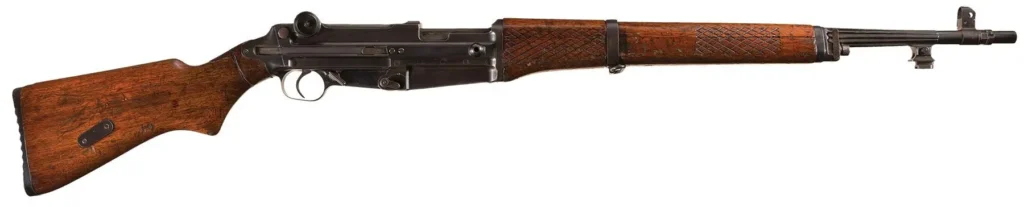
The Type Otsu self-loading rifle came from a Japanese company called Tokyo Gas & Electric Engineering (TGE&E). TGE&E copied the Czech ZH-29 rifle. This rifle used a gas-operated tilting bolt design and fired the 6.5 Arisaka. The Japanese installed a non-reciprocating bolt handle, while the Czech design attached the bolt handle to the bolt carrier.
Advertisement — Continue Reading Below
The Type Otsu held either five or ten rounds in detachable magazines. The Type Otsu aimed to be light, affordable, reliable, and accurate. The rifle was still fairly heavy at over nine pounds and was reportedly reliable. The main problem came from accuracy issues.
The rifle never met Japan’s accuracy requirement. TGE&E withdrew its rifle, and it was never considered for serious adoption. Only ten or so were ever adopted. Interestingly enough, the Chinese would wield a limited number of ZH-29 rifles against the Japanese in the Second Sino-Japanese War.
The Self-Loading Success
The Japanese would finally formally adopt a self-loading rifle in 1944. The Type 4 was a copy of the M1 Garand. It was adopted too late in the war to see any major adoption or use, but it was formally adopted by the Japanese military. The Otsu, Hei, and Ko are extremely rare rifles and are fascinating firearms, and sadly, purchasing one will cost you several thousand dollars.
Advertisement — Continue Reading Below
Read the full article here