

We talk a lot about a lot of weird and interesting firearms, guns that are often forgotten about, but what about forgotten less-lethal tools? The less-lethal option has always been an interesting challenge, and finding the right weapon to take someone down without permanent harm has been a significant challenge to overcome. Today, we are going to look at a number of less-lethal options that were innovative, odd, and largely forgotten.
Less-Lethal of Yesteryear
Peters Riot Control Cartridge
Less-lethal today means something different than less-lethal of yesteryear. In the 1920s, the idea of a less-lethal police tool was a sap or baton they smacked you in the head with. When they wanted a little extra range, they turned to the Tommy Gun loaded with the Peters Riot Control Cartridge.
Advertisement — Continue Reading Below
The Peters Riot Control cartridge was patented in 1925 and was composed of a brass case with a cardboard sabot that looked a bit like a pill. The cardboard sabot held 120 pellets of Number 8 birdshot. These rounds turned your Tommy gun into a straight-pull bolt-action rifle and fed from a proprietary magazine to prevent real .45 ACP from being mistaken for Riot Control cartridges.
Firing No. 8 birdshot doesn’t sound like a modern, less-lethal solution. It can literally poke someone’s eye out. I imagine the tactic was to aim for the legs or to skip shot off the ground. The cartridges were produced for 25 years, and the military issued the round to aircrew for killing small game in the event of a crash or ejection into the wild.
M234 Riot Control Launcher and Ring Airfoil Grenade
Who knew that weird, less-lethal tool from Splinter Cell: Double Agent was real? The Ring Airfoil Grenade and the M234 Riot Control Launcher were devices dreamed up in the age of the M16A1. The M234 Riot Control Launcher attached to the muzzle and bayonet lug of the M16A1, and a 5.56 blank was used to propel the Ring Airfoil Grenade.
Advertisement — Continue Reading Below
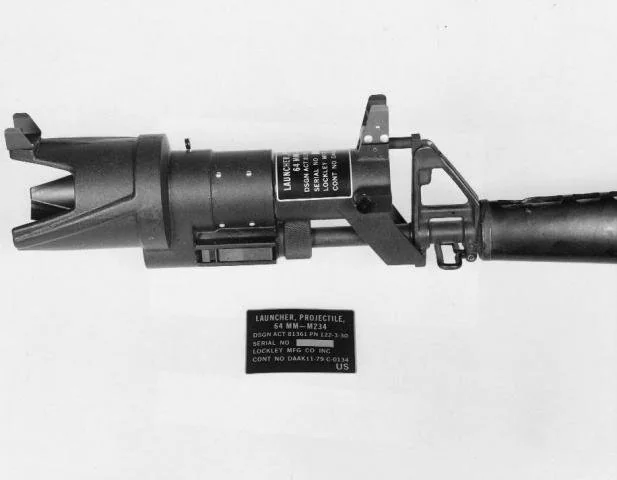
The Ring Airfoil Grenade looked a bit like a donut—not a donut of death, but a donut of less-lethal force. The RAGs came in two flavors. We had the kinetic model, which just imparts direct pain. Then we had a CS model that exploded when it hit something and dispersed a small cloud of CS to blind, disable, and discomfort the enemy.
The M234 Riot Control Launcher used a captive sabot to propel the projectiles up to 40 meters on individuals and up to 60 meters at a group of targets. The projectiles were gyroscopically stabilized and spun at 5,000 RPMs while moving at 200 feet per second. The shape of the RAG meant it gathered lift during flight and provided a flat flight path.
Advertisement — Continue Reading Below
Beretta LTLX7000
The hard part about less-lethal tools is mastering the velocity required to hit a threat effectively while balancing the lethality of the cartridge. The Beretta LTLX7000 was an attempt to create a smart shotgun system that could regulate the kinetic energy of the cartridge based on the threat’s range.
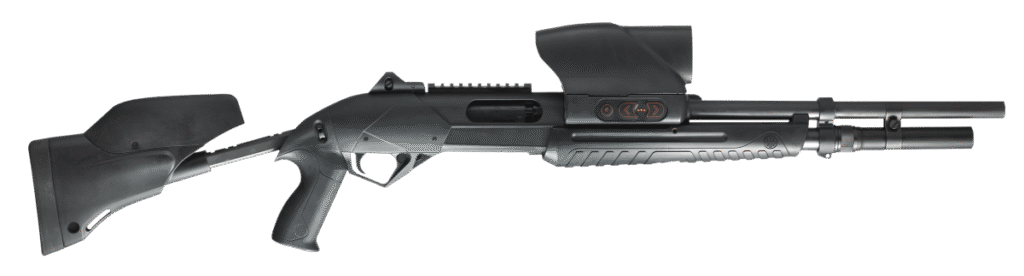
At super close ranges, it packed the same kinetic energy as threats at greater distances. The LTLX7000 uses a computer-controlled holographic sight with two red dots inside it. Shooters put one dot on the head and one dot on the feet of the target. This allowed the system to measure distance and height.
Advertisement — Continue Reading Below
The optic provided the information to a gas-venting system. The system vented gas to lower the velocity of the cartridge depending on its range. This allowed for a regulated, less-lethal option, and the gun fired a proprietary 12-gauge cartridge. From my understanding, standard 12-gauge ammunition will not load into the gun.
The LTLX7000 never left the experimental phase and seems to have been abandoned by Beretta.
TASER XREP 12
Less-lethal shotguns are typically loaded with rubber buckshot, beanbag slugs, or similar kinetic ammunition. It works by hurting the bad guy bad enough to knock him down, but not kill him. Another way to stop a threat is to use electricity in the form of a TASER. The TASER XREP 12 cartridge combined both shotguns and stun guns to make one helluva high-tech slug.
Advertisement — Continue Reading Below

TASER developed the XREP 12 cartridge to impart stun gun technology to a longer-range platform. These 12-gauge shotgun slugs launched an electrified projectile that, when striking the threat, delivered a charge along with the slap of kinetic energy. Mossberg adapted a Model 500 to utilize the cartridge, and this X12 Mossberg could not accept standard 12-gauge ammo.
The XREP cartridge gave users an effective range of 15 to 100 meters. The XREP seemed primed to be the next big thing, but has seemingly faded away. I’ve seen a few of the guns for sale, but I couldn’t justify the price for ammo I can’t acquire.
Advertisement — Continue Reading Below
The Alternative
The Alternative hasn’t exactly been forgotten about, but it should be. As far as I can tell, the website is still live and still selling the clown nose we call the Alternative. My problem with the Alternative is the fact that it uses a real gun and live cartridge.

The Alternative mounts to the front of your gun and positions an alloy ball in front of your barrel. When you fire a live cartridge, the cartridge hits the alloy ball and propels it forward. The hook is that any handgun can be a less-lethal tool, and police officers simply have to strap the Alternative device and alloy ball to an officer’s service pistol.
Advertisement — Continue Reading Below
While it seems simple and the repeated claim is that the Alloy ball travels at 20% of the velocity of a bullet, mixing real ammo with less-lethal tools is a bad idea. There is too much that can go wrong. There’s a reason why police protocol calls for a dedicated less-lethal shotgun, and you don’t mix and match ammo types.
Less Lethal, Less Memorable
The Less-Lethal world is full of oddballs. Creating a less-lethal projectile-based tool is a major challenge. It’s a balancing act of being able to stop a threat without permanently harming the attacker. It calls for creative ideas, and some of those ideas get lost and forgotten.
Advertisement — Continue Reading Below
Read the full article here